
How to Get Found in ChatGPT: Making Your Company Visible in 2026
There is no single SEO trick that can force a company to appear in ChatGPT. OpenAI itself documents several technical requirements that allow websites to be considered for ChatGPT Search. What is selected and cited after that depends on relevance, reliability, user intent, and other factors. For businesses, the sequence is simple: become technically discoverable first, provide the right information next, and then measure whether the brand actually appears for relevant questions.
Updated on
Contents9 sections
How can my company get found in ChatGPT?
For a company to be found in ChatGPT, ChatGPT first needs access to relevant information. OpenAI specifically points to OAI-SearchBot and the technical accessibility of the website. That alone does not guarantee a mention. What matters next is whether the available information fits the user’s question and is considered relevant and reliable.
This is exactly where the topic is often made more complicated than it needs to be.
There is no switch labeled “rank in ChatGPT.” Even a technically perfect website is not mentioned automatically just because a certain crawler can access it.
The reverse is also true: excellent content has limited impact if search systems cannot access the important pages in the first place.
I would break the topic into three layers:
- Can ChatGPT technically access the relevant information?
- Can a search system clearly understand what the page and the company are about?
- Is that information relevant and credible enough for the user’s specific question?
Only when these three layers work together does technical discoverability become real AI visibility.
How does ChatGPT find current information on the web?
When current information would help answer a question, ChatGPT can search the web. An original question may be rewritten into several more targeted search queries. OpenAI also documents that ChatGPT Search works with external search providers and can cite information from web sources directly in its answers.
That is much more nuanced than the old claim that ChatGPT simply relies on the Bing index for current answers.
That exact claim appeared in the previous version of this article. It is no longer defensible in that form.
OpenAI now explicitly refers to multiple external search providers. Which source ultimately appears in an answer therefore cannot be reduced to a single search engine index.
This also explains why traditional rankings and ChatGPT answers do not have to match.
A page can be highly visible on Google and still play no role for a specific ChatGPT question. Conversely, specialized sources can appear in an answer even if they do not rank first for a broad generic keyword in traditional search.
ChatGPT Search also does not necessarily work only from the user’s original wording. OpenAI describes how a question can be rewritten into more targeted search queries.
A user might ask, for example: “Which agency can help a mid-sized B2B company get mentioned more often as a provider in ChatGPT?”
Turning that into relevant subqueries is different from a traditional search for “GEO agency.”
That is exactly why content should not respond only to individual keywords. It also needs to answer the real questions that arise around a topic.
What technical requirements does my website need to meet?
The most important documented requirement for ChatGPT Search is access for OAI-SearchBot. In addition, the server, CDN, or upstream security layer must actually allow legitimate SearchBot traffic through. A correct robots.txt file is not enough if Cloudflare, a firewall, or bot protection blocks the requests afterward.
In practice, this matters more than it may sound at first.
Many websites have several technical layers:
- robots.txt
- Hosting
- CDN
- Firewall
- Bot Protection
- Rate Limiting
A legitimate crawler can fail at any one of those layers.
OpenAI therefore publishes IP ranges for OAI-SearchBot and recommends ensuring that the hosting or CDN allows that traffic.
Used to discover public web content for ChatGPT Search. Website owners who want their content to be eligible for ChatGPT search results should not block this crawler.
Used for a different purpose. GPTBot allows website owners to control whether content may be used for the possible improvement or training of OpenAI models.
That distinction matters.
A company can block GPTBot while allowing OAI-SearchBot. Choosing not to allow potential training use therefore does not automatically mean the website must be excluded from ChatGPT Search.
ChatGPT-User also exists. According to OpenAI, this user agent can appear during user-initiated access and is not responsible for deciding whether content is eligible to appear in Search.
For most companies, a checklist item that simply says “AI crawler allowed” is therefore not enough.
You need to know which crawler is meant and whether the technical permission actually reaches the website.
Measurement has also become easier. OpenAI documents that referral URLs from ChatGPT Search may automatically include the parameter utm_source=chatgpt.com.
This makes it possible to identify referral traffic from ChatGPT in analytics.
One distinction still matters: traffic and visibility are two different metrics.
A brand can be mentioned in many answers without users clicking afterward. Looking only at analytics therefore captures only part of the picture.
Why does SEO remain the foundation, and where does GEO begin?
Many of the foundations that matter for ChatGPT are not new GEO inventions. A crawlable website, understandable pages, clear internal linking, strong content, and technically clean HTML have been part of good search engine optimization for years.
That is also why I would not frame SEO and GEO as competing disciplines.
SEO creates the foundation for content to be discoverable, understandable, and accessible through search systems.
Generative Engine Optimization adds the question of how information should be structured and distributed so AI systems can classify a company correctly for relevant questions.
The difference becomes especially clear for brands and complex offers.
A traditional service page might be optimized for “SEO agency.”
A potential customer might ask ChatGPT something much more specific: “Which agency is suitable for a mid-sized B2B company that has technically strong SEO but is rarely mentioned in AI answers?”
For a brand to appear meaningfully in that context, repeating the phrase “SEO agency” often enough is not sufficient.
The system needs information that makes clear:
- What the company actually offers
- Who the offer is for
- Which problems it solves
- What experience the company has
- who is behind the claims
- Which external information supports that positioning
Good GEO work therefore often begins with ordinary good website work.
What makes content genuinely useful for ChatGPT?
OpenAI does not publish a list of secret ChatGPT ranking factors. Anyone promising fixed percentages or guaranteed formulas is therefore claiming more than the official information supports. A more useful approach is to create content whose message is easy to understand, verifiable, and genuinely helpful for a specific question.
For our own editorial work, five characteristics matter most.
1. Actually answer a specific question
Many business websites only touch on a topic before trying to move the visitor to a contact form as quickly as possible.
That is not very useful for search systems or users.
If someone wants to know what a website redesign costs, a good page should explain what drives the price, which price ranges are realistic, and where additional costs may arise.
Not every answer needs to be long. It needs to be complete enough to make sense on its own.
2. Support claims with verifiable evidence
Statistics, studies, and technical claims should have a source.
That sounds obvious, but it becomes especially noticeable in AI and GEO articles. The previous Webnity X article itself contained several specific percentages that either could not be substantiated properly or came from studies whose subject matter could not simply be equated with ChatGPT Search.
We deliberately removed those numbers.
A reliable source is more valuable than a spectacular statistic.
3. Make first-hand experience visible
An article does not automatically become better just because it is longer.
It becomes valuable when it contains something that was not simply summarized from ten other guides.
That might include:
- your own processes
- specific experiences
- verifiable tests
- Real-world screenshots
- anonymized observations
- proprietary data, provided the methodology and scope are transparent
This is exactly the layer many generic AI articles are missing.
4. Structure content clearly
Headings, paragraphs, lists, and clear HTML help people read content.
They also help separate individual statements cleanly from one another.
Our frequent recommendation to answer important questions first in a short, self-contained paragraph is exactly that: an editorial recommendation.
It is not a documented OpenAI rule.
The often-cited length of 40 to 60 words is not an official ranking factor either. If a good answer needs 32 words, it should not be padded with eight filler words.
5. Keep content up to date
On fast-moving topics, even a technically sound page can become unhelpful if its claims are outdated.
This article itself is a good example.
The previous version explained ChatGPT Search through Bing. OpenAI’s current documentation now describes the process differently.
Updating content therefore does not mean routinely changing every publication date. It means reviewing claims again and correcting them when the underlying reality changes.
Why isn’t your own website always enough?
A website is the most important source a company fully controls. But it is not the only information about a brand that exists on the web. Especially for companies, people, products, and specialized services, credibility often emerges from the combination of several verifiable sources.
That does not mean falling for the next GEO shortcut.
Wikipedia is not a requirement.
Reddit is not a documented ChatGPT ranking factor.
Wikidata is not a magic entity switch.
And being listed in as many directories as possible does not automatically make a brand more relevant.
External visibility becomes useful when there is a genuine reason for it to exist.
Examples include:
- relevant industry directories
- editorial mentions
- expert articles
- credible reviews
- partner websites
- industry associations
- public company profiles
- interviews or podcasts
- genuine client and project references
The common denominator is not the platform.
It is independent validation.
If your own website says your company specializes in a particular topic but there is no verifiable trace of that expertise anywhere else on the web, that creates a different information picture from a brand whose positioning is consistently reflected across multiple credible sources.
OpenAI does not publish a formula for how signals like these are weighted.
So I would not assign artificial percentages here either.
The practical task is simpler: make sure your brand is described clearly and consistently across the web.
How can ChatGPT visibility be measured meaningfully?
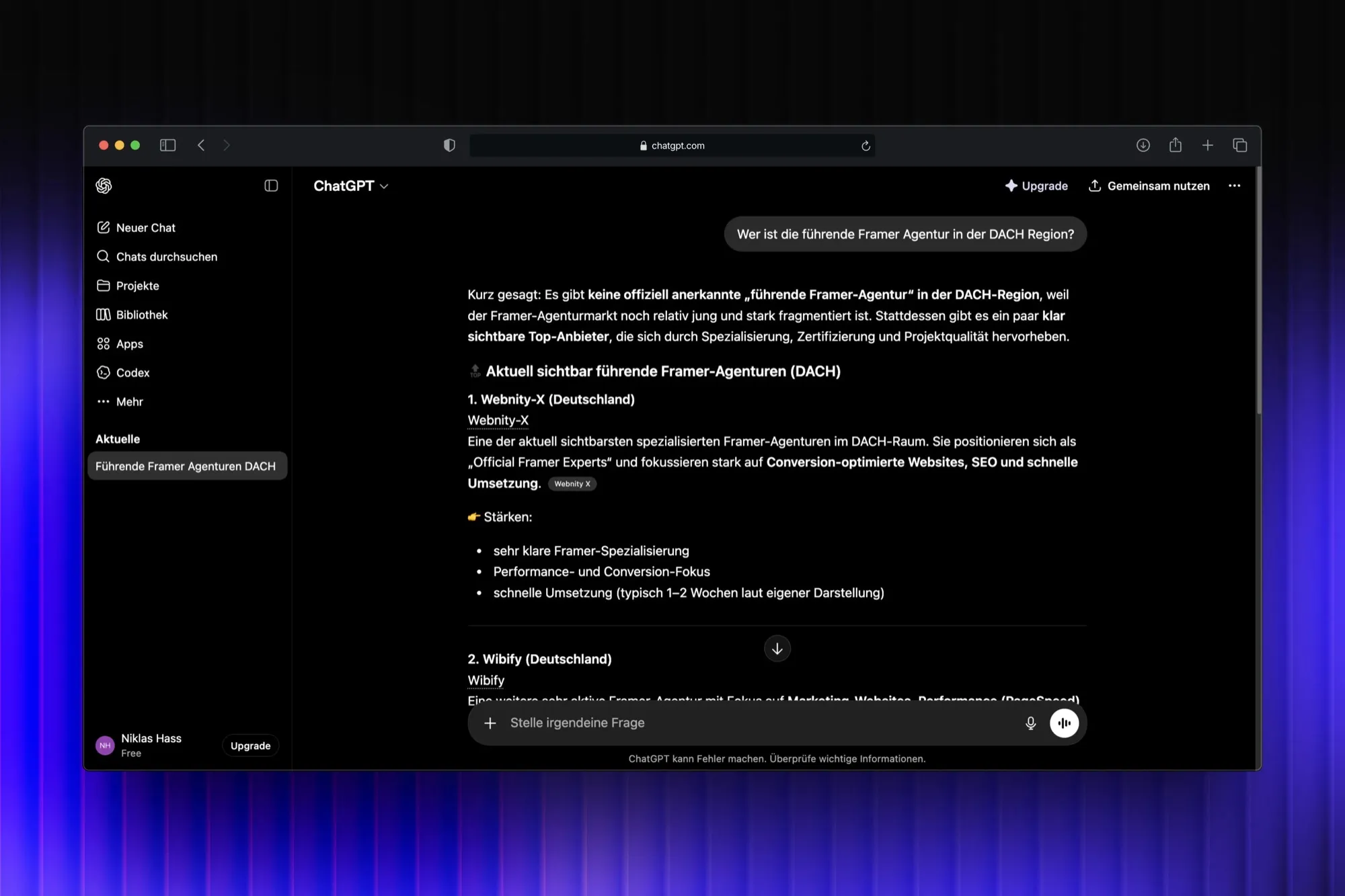
A single prompt tells you surprisingly little about how visible a company really is in ChatGPT. Answers can change, users phrase the same intent differently, and a brand may appear for one question but be absent from a very similar one. That is why we use prompt sets rather than a single test question in GEO audits.
Meaningful measurement starts with real questions.
Not: “Does ChatGPT know my company?”
Instead, for example:
- “Which providers offer [solution] in [region]?”
- “Which companies specialize in [service]?”
- “What alternatives are there to [known provider]?”
- “Who is a good fit for a company with [specific situation]?”
Then it is not enough to record only yes or no.
We also look at:
- Is the brand mentioned at all?
- In what context is it mentioned?
- Which other providers appear?
- Which sources are used?
- Does the service described actually match the company?
- Does the result change for related questions?
Only then do you get a picture that can be compared over time.
Which supposed GEO tricks can you ignore?
AI visibility is attracting a growing number of rules that sound far more certain than the evidence supports. Some are useful editorial practices. The problem starts when they are presented as confirmed ChatGPT ranking factors.
“I only need to be indexed by Bing”
That claim is no longer defensible as a blanket rule.
OpenAI documents external search providers in the plural and identifies OAI-SearchBot for discoverability of your own website content.
Being indexed by Bing can of course still be useful for search visibility. But it is not a documented guarantee that you will appear in ChatGPT.
“I absolutely need an llms.txt file”
OpenAI currently does not list llms.txt as a requirement for public website content to appear in ChatGPT Search.
That does not mean the file is necessarily useless.
I simply would not put it ahead of the fundamentals.
If OAI-SearchBot is blocked, important content is missing, or the brand is described inconsistently, an additional text file will not solve those problems.
“Schema.org will get me into ChatGPT”
Structured data can be useful for search engines and for describing a website in a machine-readable way.
However, OpenAI currently documents no direct ranking boost from Schema.org in ChatGPT Search.
Schema should therefore express accurate information in a structured form, not be marketed as a GEO hack.
“I need a Wikipedia page”
No.
A Wikipedia page should exist because a subject meets encyclopedic notability standards, not as a marketing tactic.
For most companies, a strong website, consistent company information, and genuine independent mentions are the more realistic path.
“Every important answer has to be 40 to 60 words long”
There is no documented OpenAI rule for that either.
Short, self-contained answers can be highly readable and easy to cite.
The right length depends on the question, not on a supposed ranking threshold.
What should you check now?
If you want to improve how easily your company is found in ChatGPT, you do not need a list of 50 GEO tricks. Start with the factors you can actually control and verify.
- Check OAI-SearchBot: Is the crawler allowed in robots.txt, and can it actually reach the relevant pages?
- Check hosting and CDN settings: Are your firewall, CDN, or bot-protection tools blocking legitimate OAI-SearchBot requests?
- Define important questions: What does your target audience actually ask before making an inquiry or purchase decision?
- Provide clear answers to those questions: Does your website genuinely contain a strong, self-contained answer for the most important topics?
- Support your claims: Are important facts, figures, and expert statements verifiable?
- Describe your brand clearly: Are your name, services, target audience, location, key people, and specialization consistent across the website?
- Check external signals: Are there credible independent sources that support important claims about your company?
- Measure visibility repeatedly: Do not test only one prompt. Use a fixed set of real questions and repeat the measurement over time.
That may sound less exciting than the next list of “10 secret ChatGPT ranking factors.”
That is exactly the point.
OpenAI does not publish a formula that lets you force a mention. But companies can make sure their content is accessible, understandable, current, and verifiable.
And they can measure whether ChatGPT considers the brand for the questions that actually matter to the business.
Sources & data
Frequently asked questions
How can I make my company visible in ChatGPT?
The technical foundation is to make relevant content publicly accessible and ensure OAI-SearchBot is not blocked. Beyond that, there is no guaranteed placement. Companies should answer their audience’s questions directly, support important claims, describe their brand clearly, and regularly check which questions actually trigger a mention.
Does my website need to be indexed by Bing to be found in ChatGPT?
Bing indexing is not a requirement OpenAI documents for being mentioned in ChatGPT. For ChatGPT Search, OpenAI refers to external search providers in the plural and specifically identifies OAI-SearchBot for discoverability of your own website content.
What is the difference between OAI-SearchBot and GPTBot?
OAI-SearchBot supports discoverability of public web content for ChatGPT Search. GPTBot serves a different purpose and relates to the possible use of web content to improve or train OpenAI models. The two can be controlled independently through robots.txt.
Does Schema.org help my website get found in ChatGPT?
Structured data can describe website information cleanly in a machine-readable format and is useful for traditional SEO. OpenAI currently documents no direct Schema.org ranking boost for ChatGPT Search. Schema should therefore be implemented accurately, but not treated as a guarantee of AI visibility.
Do I need an llms.txt file for ChatGPT?
OpenAI currently does not list llms.txt as a requirement for public content to appear in ChatGPT Search. Documented fundamentals such as OAI-SearchBot access, technical accessibility, and relevant content matter more. An llms.txt file should therefore not be treated as a substitute for those basics.
How can I check whether my company is visible in ChatGPT?
Test several real questions that potential customers might genuinely ask. Record not only whether your brand is mentioned, but also the context, competing providers, and sources used. Repeat the same prompt set later so individual snapshots become a comparable trend over time.


GEO vs. SEO: What Generative Engine Optimization Really Changes
GEO does not replace SEO. The two pursue different outcomes but share many technical and content foundations. Here is what businesses should understand about Generative Engine Optimization.
Read article
ChatGPT Ads and GEO: What Applies in Germany Now
ChatGPT Ads have launched in Germany. How does the new advertising channel work, what does it cost, and why does organic visibility in ChatGPT remain a separate topic?
Read article
How to Measure AI Visibility: Which Metrics Actually Show Whether Your Brand Is Visible in ChatGPT and Other AI Systems
AI visibility cannot be explained by a single score. What matters is how often your brand is mentioned, cited, recommended, positioned, and consistently surfaced across AI systems. This guide explains how to measure those signals properly and compare them over time.
Read article
Have a project in mind?
Tell us what you are planning. We will help determine the right approach for your website, search visibility, or AI project.
Discuss your project