
Framer 2026: The Complete Guide to Pricing, CMS, SEO, AI, Alternatives & Top Framer Agencies
In 2026, Framer is particularly strong for high-quality marketing websites, B2B websites, SaaS companies, startups, landing pages, and design-led corporate sites. If you need a large online store, a highly complex web application, or very extensive editorial systems, you should compare Framer against specialized alternatives.
Contents26 sections
Is Framer a good website platform in 2026?
Framer has grown from a design and prototyping tool into a complete platform for professional websites. CMS, hosting, SEO, AEO, analytics, A/B testing, localization, branching, and the new Framer Agents have expanded its scope considerably. It is strongest for marketing, B2B, SaaS, and design-led business websites.
In just a few years, Framer has grown from a design and prototyping tool into a complete platform for professional websites. By 2026 it is no longer interesting only to designers building unusually attractive landing pages. CMS, hosting, SEO, AEO, analytics, A/B testing, localization, branching, and above all the new Framer Agents have expanded what the platform can do.
This guide answers exactly that. We do not look at Framer in isolation. We compare it with the major alternatives, explain pricing and features, cover the most important changes from 2026, and map the international Framer agency market.
Webnity-X works with Framer professionally and is listed as a Framer Expert Agency in the official Framer Experts directory. So let's be upfront: we have a commercial interest in Framer projects, and this article uses an affiliate link to Framer in one place. Our assessment of the platform's strengths and limits is independent of that.
Short answerIn 2026, Framer is particularly strong for high-quality marketing websites, B2B websites, SaaS companies, startups, landing pages, and design-led corporate sites. If you need a large online store, a highly complex web application, or very extensive editorial systems, you should compare Framer against specialized alternatives.
What is Framer?
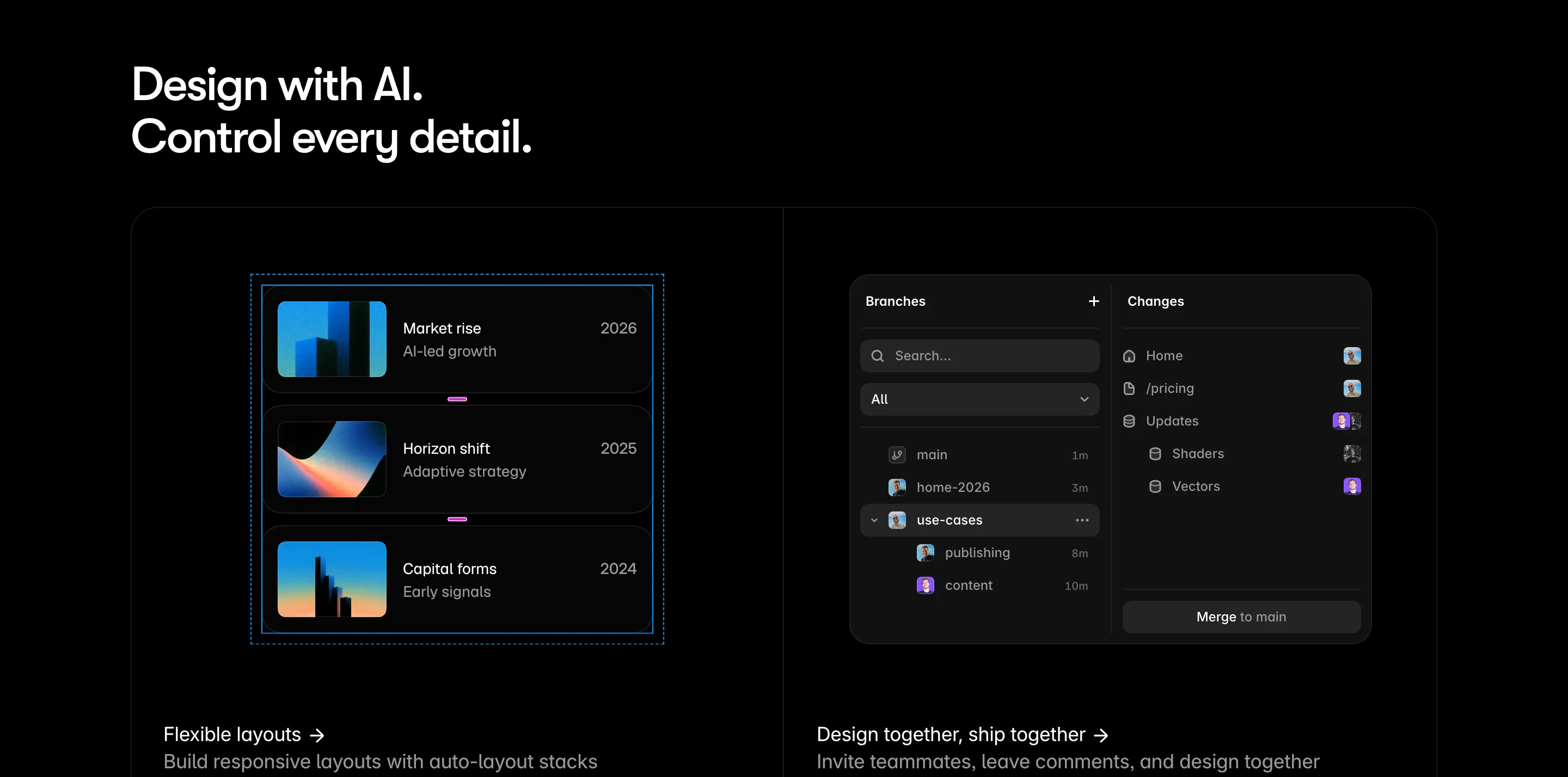
Framer is a visual website platform for designing, managing, hosting, and publishing websites. What sets it apart is how closely the design and the published site sit together: teams work directly on a visual canvas that becomes the live website, rather than handing a static layout to developers.
Framer is a visual website platform for designing, managing, hosting, and publishing websites. What sets it apart is how closely the design and the published site sit together.
In a traditional design-to-development process, a static layout is produced in a design tool and then rebuilt by developers. In Framer, the team works directly on a visual canvas that becomes the live website.
As of 2026, Framer covers:
- visual web design and responsive design
- components and design systems
- a CMS
- animations and effects
- integrated hosting
- SEO and AEO features
- Framer Agents and external AI agents
- localization
- analytics
- A/B testing through Framer Convert
- staging and branching
- plugins and APIs
- enterprise features
That places Framer well beyond the scope of a classic no-code website builder.
How big is Framer in 2026?
Framer is still considerably smaller than WordPress, Wix, or Squarespace, but it is no longer a niche tool. The platform now has a substantial international ecosystem of companies, agencies, experts, templates, plugins, and professional service providers. Absolute website counts and CMS market shares cannot be combined into a single figure, because technology databases measure differently.
Framer is still considerably smaller than WordPress, Wix, or Squarespace. Even so, the platform is now large enough that treating it as a niche tool no longer makes sense.
A note on market size: different technology databases measure websites using different methods. Absolute website counts and CMS market shares therefore cannot be combined into a single figure.
The core point stands: Framer is younger and smaller than the established systems, but it now has a real international ecosystem of companies, agencies, experts, templates, plugins, and professional service providers.
Why Framer is worth a serious look in 2026
2026 was an unusually large product year for Framer. The official update history lists 32 releases between March and October, including Framer 3.0, CMS 3.0, Framer Convert, Skills, new agent models, 3D transforms, Static Files, Firewall, and Branching APIs. The central release is Framer 3.0, which bundled Agents, Branching, Community, and a redesigned interface.
2026 was an unusually large product year for Framer.
The official update history we reviewed lists 32 relevant releases between March and October. They include Framer 3.0, CMS 3.0, Framer Convert, Skills, new agent models, 3D transforms, Static Files, Firewall, Branching APIs, and a long run of new shaders.
Source: Framer — UpdatesThe central release is Framer 3.0, which bundled Agents, Branching, Community, and a redesigned interface.
That also shifts how the platform is positioned. Framer no longer competes only with Webflow, Wix, or Squarespace. The company now publishes comparison pages against Lovable, Claude Code, ChatGPT, and Codex.
Framer pricing in 2026
Framer offers four tiers: Free at $0, Basic at $10 and Pro at $30 per month with annual billing, and Enterprise with custom pricing. With monthly billing, Basic and Pro are $15 and $45. Pro adds staging, branching, redirects, site search, and add-ons.
Framer currently offers four tiers:
| Plan | Price | Key allowances |
|---|---|---|
| Free | $0 | Framer domain, 1 GB bandwidth, 500 AI credits to try |
| Basic | $10 per month, billed annually | custom domain, 30 pages, 2 CMS collections, 1,000 CMS items, 50 GB bandwidth, 1,000 credits per month, up to 10 seats |
| Pro | $30 per month, billed annually | custom domain, 150 pages, 10 CMS collections, 2,500 CMS items, 100 GB bandwidth, 3,000 credits per month, staging, branching, redirects, site search, add-ons |
| Enterprise | custom pricing | custom limits, unlimited editors, SSO, SCIM, enterprise security, uptime guarantee, Advanced Hosting included |
These values were read directly from Framer's live pricing interface and matched to the correct columns. One detail matters: the large comparison table on Framer's pricing page has no separate Free column, which is why plain text extraction tends to shift the numbers by one plan.
With monthly rather than annual billing, Basic and Pro currently come to $15 and $45.
Framer serves pricing regionally. US visitors see dollar amounts; visitors in Germany currently see the same figures in euros.
What do the add-ons cost?
On Pro, additional capacity can be purchased:
| Add-on | Price |
|---|---|
| 100 additional pages | $20 |
| 10 additional CMS collections | $40 |
| 10,000 additional CMS items | $20 |
| 100 GB additional bandwidth | $40 |
| Additional editor | $20 per month |
| Content editor | $10 per month |
| Additional locale | $20 |
| Advanced Hosting | $200 |
| Convert | $50 per 500,000 events |
Which plan do companies actually need?
for a small business website.
as soon as a professional redesign involves redirects, staging, branching, or a larger CMS.
On a migration from WordPress or Webflow, redirects are not a luxury. Existing URLs have to point cleanly at the new pages so that rankings and inbound links are not lost along the way.
If you want to evaluate the platform yourself, you can try Framer for free.Disclosure: This is an affiliate link. If you subscribe to Framer through it, we may receive a commission at no additional cost to you.
Framer CMS: how capable is it in 2026?
CMS 3.0 rebuilt the system in 2026, adding the List field, on-page content editing, and more options for structured content. Pro starts at 2,500 CMS items and ten collections; with add-ons Framer states a maximum of 40,000 items, 40 collections, and 2 TB of bandwidth.
The CMS has become one of Framer's most important features.
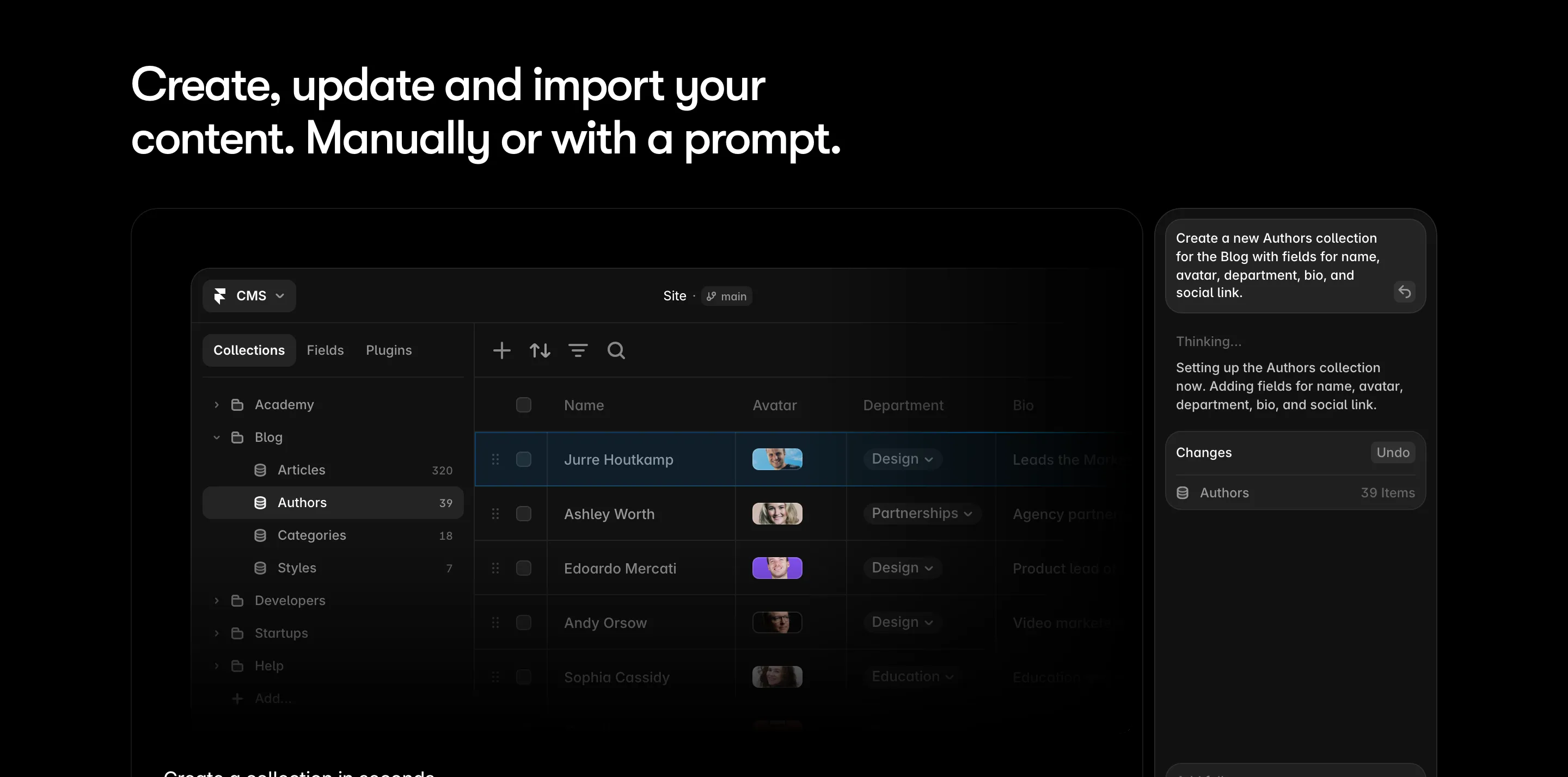
CMS 3.0 rebuilt the system in 2026. It brought the List field, content editing directly on the page, and more room for structured content.
The CMS supports:
| Area | Supported |
|---|---|
| Field types | Text, image, rich text, date, reference, toggle, icon, color, file, and link |
| Rich text | Code blocks, tables, blockquotes, and galleries |
| References | Connecting different collections |
| List fields | Repeatable structured content |
| Filtering | Search, tabs, toggles, and dropdowns |
| Sorting | Text, date, number, and boolean, with multiple rules combined |
| Drafts | Prepare content before it goes live |
| Localization | Multilingual CMS content |
| Import | CSV, Google Sheets, and Airtable |
| Agents | Edit content and structures with AI |
The List field is the most interesting recent addition. Instead of creating ten separate fields for ten FAQ entries, repeatable content lives in one structured list.
For blogs, FAQ systems, feature lists, comparison pages, or case studies, that is a meaningful step toward content structures that scale.
How large can a Framer CMS get?
On Pro, Framer currently starts at 2,500 CMS items and ten collections.
With add-ons, Framer states a maximum of 40,000 CMS items, 40 CMS collections, and 2 TB of bandwidth.
Framer's separate CMS page also advertises “Up to 100K items”, but names no plan there. Those 100,000 items should therefore not be attributed to the Pro plan.
Which CMS projects suit Framer?
For business websites, magazines, blogs, case studies, resource libraries, team pages, landing page systems, or smaller directories, Framer is now very capable.
If a project needs hundreds of thousands of records, complex editorial roles, substantial backend logic, or heavily relational data models, it is worth checking whether a headless CMS or another system fits better.
Is Framer good for SEO?
Framer provides a broad technical SEO foundation in 2026, including custom titles and meta descriptions, dynamic CMS metadata, canonical URLs, sitemaps, redirects, structured data, image optimization, and server-side rendering. Rankings still depend on content, structure, search intent, and authority. Framer also uses traffic-aware pre-rendering and static site generation, and serves images at the edge as WebP or AVIF.
Available natively:
- custom titles and meta descriptions
- dynamic CMS metadata
- canonical URLs
- sitemaps
- redirects
- alt text
- semantic HTML
- structured data
- social preview images
- server-side delivery
- image optimization
- SEO audits through Agents
- internal link suggestions
- Search Console and analytics integrations
Framer also uses Traffic-aware Pre-Rendering and static site generation.
Images can be served at the edge as WebP or AVIF. Offscreen content is loaded after the initial viewport, and Framer uses predictive preloading for links that enter the viewport.
That is a solid technical base. SEO still comes down to information architecture, content, search intent, internal linking, authority, and technical execution.
No website builder replaces that strategy. How we combine SEO with technical delivery is covered on our B2B SEO services page.
Framer and AI search: is Framer ready for ChatGPT, Gemini, and AEO?
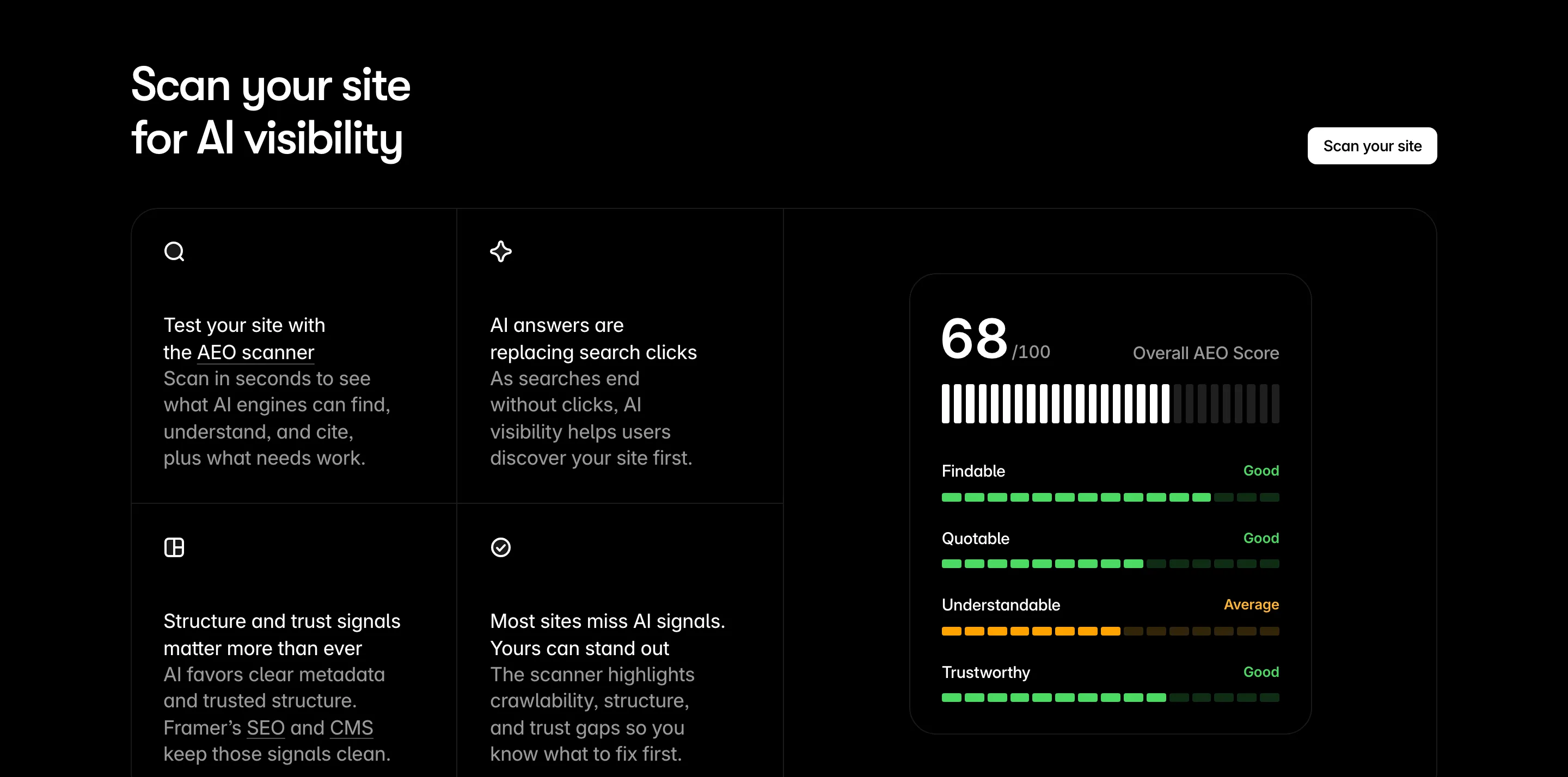
Framer now talks about AEO and AI visibility directly. It supports llms.txt, structured data, server-side content, semantic markup, sitemaps, and ships its own AEO scanner. Framer supplies the technical infrastructure; whether a site appears in AI answers depends on content and authority.
This is where Framer made a genuinely interesting move in 2026. The company now talks about AEO and AI visibility directly on its own product pages.
The platform offers:
- support for llms.txt
- structured data
- content available server-side
- semantic markup
- its own AEO scanner
- agent-based SEO audits
- sitemaps
- clean metadata
The llms.txt support deserves particular attention. Framer lets you serve such files through Static Files, in the same way as robots.txt or security.txt.
None of that means a Framer site is automatically recommended inside ChatGPT or Gemini. Framer supplies the technical infrastructure.
Actual visibility in AI answers still requires:
- entity building
- quotable content
- external mentions
- structured answers
- trustworthy sources
- appropriate schema data
- a clear brand position
Framer covers the technical groundwork. Whether a website shows up in AI answers comes down to content and authority — which is exactly what our AI search optimization work addresses.
Framer Agents: what can the AI actually do in 2026?
Framer Agents can build new sites and sections, change content and styles, fix responsive issues, manage CMS content, analyze SEO and analytics, audit sites, create custom components, and migrate existing websites. Strategy, brand understanding, and quality control remain human work.
Framer Agents are among the biggest changes to the platform in 2026.
Agents can:
- build new websites and sections
- change existing content
- alter design styles
- fix responsive problems
- manage CMS content
- analyze SEO and analytics
- audit websites
- create custom components
- migrate existing websites
Framer names migration from live URLs, screenshots, or exports explicitly as a use case.

External Agents
External Agents are the more interesting development. Framer can connect to Claude Code, Cursor, Codex, and other AI tools. According to Framer, no separate MCP setup is required.
Skills
Skills store reusable instructions — design system rules, writing style, CMS workflows, component conventions. Agents can reference @pages, @components, and @styles inside a project.
Models and credits
Several new models arrived in 2026, including Opus 5, Sonnet 5, Fable 5, and GPT 5.6 variants. Framer also supports different reasoning levels and a fast mode.
| Plan | Credits |
|---|---|
| Free | 500 credits to try |
| Basic | 1,000 credits per month |
| Pro | 3,000 credits per month |
| Enterprise | custom |
Do Agents replace a Framer agency?
No. Agents speed up work, generate variations, surface errors, and take over repetitive tasks.
Strategy, brand understanding, information architecture, conversion logic, high-quality design, and quality control remain human work.
Framer itself frames Agents as a tool inside an editable workflow rather than a fully autonomous website factory.
What is Framer Motion — and is that still its name?
Framer Motion is now called Motion. It is an independent open-source animation library for React, JavaScript, and Vue, previously known as Framer Motion. Framer uses Motion for its own animations, but the library is not simply the animation feature of the Framer website builder.
This causes a lot of confusion.
Motion is an independent open-source animation library for React, JavaScript, and Vue. It was previously known as Framer Motion.
Framer uses Motion for its own animations, but the library is not simply “the animation feature of the Framer website builder”.
For most websites you never need to write Motion code. Framer already provides extensive animations, interactions, transforms, and effects on the canvas.
In 2026, a long run of shaders was added on top of that.
Shaders: one of Framer's most underrated 2026 features
Nine of the 32 Framer releases we reviewed in 2026 concern visual effects or shaders, including Chromatic Aberration, Holo, Logo Shaders, Ripple, Liquid Gradient, and Video Shaders. 3D transforms with multi-axis rotation, perspective, depth, and backface control arrived as well.
Nine of the 32 Framer releases we reviewed in 2026 concern visual effects or shaders. That makes effects the most heavily worked product area of the year.
Source: Framer — UpdatesThey include:
- Chromatic Aberration
- Holo
- Logo Shaders
- Spectrum
- Crystal
- Ripple
- Liquid Gradient
- Logo Gradient
- Video Shaders
3D transforms with multi-axis rotation, perspective, depth, and backface control arrived as well.
For brand websites this matters, because high-quality motion and interaction become far easier to build inside the design process itself.
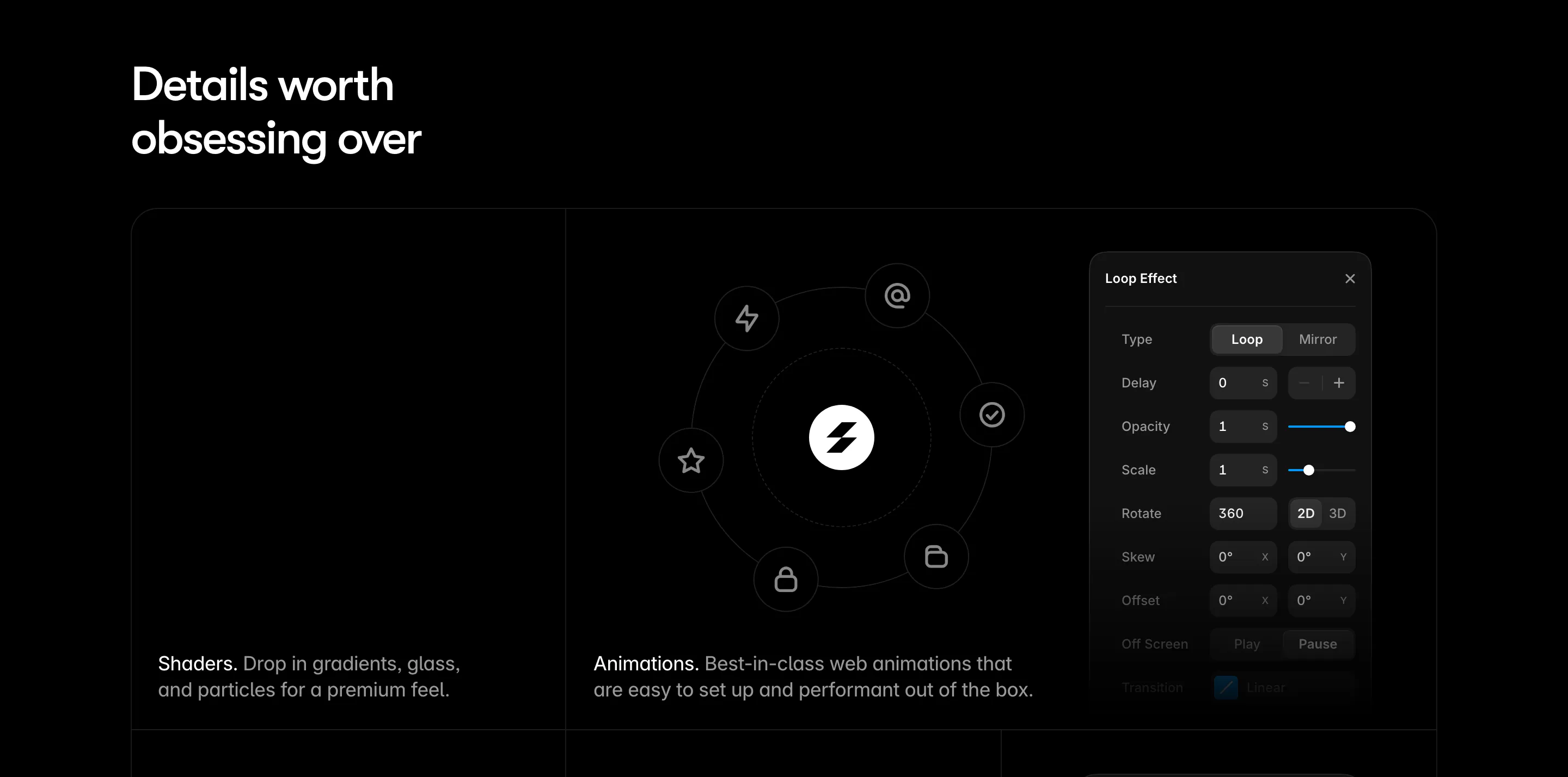
An effect being available is not a reason to use it. Good animation supports hierarchy, storytelling, orientation, and interaction. It should not compete with the message.
Hosting and performance
Framer handles hosting entirely, including CDN, SSL, pre-rendering, static site generation, image optimization, predictive preloading, staging, and branching. Basic uses a CDN with 20 locations, Pro more than 300. Hosting, cache, SSL, and CDN all sit inside the platform. Framer also names Brotli and Gzip compression, lazy loading, Rolldown bundling, and cold-start protection.
Framer handles hosting entirely. The technical feature set includes:
- CDN
- SSL
- pre-rendering
- static site generation
- image optimization
- Brotli
- Gzip
- WOFF2
- predictive preloading
- lazy loading
- concurrent React rendering
- staging
- branching
- Advanced Hosting
According to the current pricing overview, Basic uses a CDN with 20 locations. Pro uses more than 300.
Framer also names Traffic-aware Pre-Rendering, server-side lazy loading, AVIF and WebP image delivery, virtualization and culling, Rolldown bundling, warm pools, and cold-start protection.
Framer Convert: A/B testing inside the Framer ecosystem
Framer Convert brought funnels, analytics, and A/B testing further into the platform in 2026. Convert is available as an add-on on Pro and currently costs $50 per 500,000 events, which matters mainly to SaaS, B2B, and growth teams. It brings website optimization closer to design and publishing, inside the same platform.
With Framer Convert, Framer brought funnels, analytics, and A/B testing further into the platform in 2026.
This matters mainly to SaaS, B2B, and growth teams, because website optimization moves closer to design and publishing. How we turn that into measurable improvement is covered on our conversion rate optimization page.
Framer vs Webflow
Framer and Webflow are both visual website platforms with different approaches: Framer offers a free design-led canvas, Webflow works closer to CSS and class conventions. For high-end B2B, SaaS, and marketing sites we would often pick Framer; for very large CMS structures Webflow can be the better call.
Framer and Webflow are the two most prominent visual website platforms. Their approaches differ.
| Platform | Approach | CMS, content, and AI | Best suited for |
|---|---|---|---|
| Framer | free, design-led canvas | CMS inside the canvas, Agents built in | marketing, SaaS, and brand websites |
| Webflow | closer to CSS and class conventions | established CMS and developer ecosystem | structured, more complex web systems |
| WordPress | themes, plugins, and page builders | largest plugin ecosystem | specialized plugins, complex editorial work, WooCommerce |
| Wix | broad small-business platform | commerce, bookings, payments, and CRM in one system | small businesses needing many operational functions |
| Squarespace | template- and system-driven | curated system with business functions | portfolios, service businesses, simple stores |
| Figma Sites | design and product design platform | does not carry through to the published site | design work, not the published website |
| Criterion | Framer | Webflow |
|---|---|---|
| Design | free, design-led canvas | closer to CSS and class conventions |
| Learning curve | often faster for designers | more technical |
| CMS | tightly tied to canvas and Agents | established CMS and developer ecosystem |
| AI | Agents built into the project | AI and developer workflows |
| Code | code components, APIs, external agents | extensive Webflow ecosystem |
| Best suited to | high-end marketing, SaaS, and brand websites | structured and more complex web systems |
Our readFor high-end B2B, SaaS, and marketing websites, we would often choose Framer today.
For very large CMS structures, or teams that deliberately want to stay closer to a traditional CSS and development model, Webflow can remain the better choice.
Framer vs WordPress
WordPress remains by far the largest CMS ecosystem, and its greatest strength is also its greatest complexity. Framer is usually better for modern marketing websites with high design standards; WordPress for specialized plugins, complex editorial workflows, or WooCommerce. Framer bundles themes, plugins, hosting, caching, security, and updates into a single platform.
WordPress remains by far the largest CMS ecosystem.
Its greatest strength is also its greatest complexity:
- themes
- plugins
- page builders
- hosting
- caching
- security
- updates
- custom extensions
Framer bundles considerably more of that into a single platform.
a modern marketing or corporate website is the focus, design quality matters, and the team wants to carry as little technical maintenance as possible.
you need highly specialized plugins, complex editorial workflows, WooCommerce, or substantial custom backend functionality.
We cover the full platform comparison in a dedicated article on Framer vs WordPress. If you are weighing alternatives more broadly, our WordPress alternatives guide covers eight platforms.
Framer vs Wix
Wix is positioned as a broad small-business platform combining website builder, commerce, bookings, payments, and CRM. Framer concentrates on design, brand, content, motion, and marketing, and fits better when a custom brand website and design control come first. Wix fits better when a small business needs as many operational functions as possible inside one system.
Wix is positioned as a broad small-business platform.
It combines a website builder with commerce, bookings, payments, CRM, and other business functions.
Framer concentrates on design, brand presence, content, motion, marketing, and AI-assisted site creation.
a custom brand website and a high degree of design control come first.
a small business needs as many operational functions as possible inside one system.
Framer vs Squarespace
Squarespace takes a more template- and system-driven approach that suits smaller websites, portfolios, service businesses, and simple stores. Framer offers more freedom in layout, responsive design, components, motion, and custom brand expression. Framer suits custom-designed marketing and brand websites; Squarespace suits companies that deliberately want a curated system with business functions included.
Squarespace takes a more template- and system-driven approach.
That makes it attractive for smaller websites, portfolios, service businesses, and simple stores.
Framer offers more freedom in layout, responsive design, components, motion, and custom brand expression.
custom-designed marketing and brand websites.
companies that deliberately want a curated system with business functions included.
Framer vs Figma Sites
Figma is primarily a design and product design platform; Framer carries the design process through to the published website. What you build on the Framer canvas can be published directly as a production site, together with CMS, SEO, hosting, and publishing.
Figma and Framer come from a similar design world but solve different problems.
Figma is primarily a design and product design platform. Framer carries the design process through to the published website.
On top of that come CMS, SEO, hosting, Agents, localization, and publishing.
When is Framer the right choice?
Framer is particularly compelling for B2B companies, SaaS companies, AI startups, technology companies, consultancies, agencies, brand websites, landing pages, content-led marketing sites, international websites, and redesigns with high design standards. Framer is strongest when marketing and design need to publish changes frequently, without a separate development process for every small adjustment.
In 2026, Framer is particularly compelling for:
- B2B companies
- SaaS companies
- AI startups
- technology companies
- consultancies
- agencies
- brand websites
- landing pages
- content- and SEO-driven marketing sites
- international websites
- redesigns with high design standards
Framer is strongest when marketing and design need to publish changes frequently.
When would we not recommend Framer?
Alternatives deserve serious consideration when the store is the core product and grows complex, when hundreds of thousands of CMS records are needed, when a custom web application is being built, when complex backend processes are required, or when full code portability is mandatory.
Framer is not automatically the best platform for every project.
We would seriously weigh alternatives when:
- the store is the core product and grows complex
- hundreds of thousands of CMS records are needed
- a custom web application is being built rather than a marketing site
- complex backend processes are required
- an existing WordPress system depends on essential specialized plugins
- full code portability is a hard requirement
A good agency should not sell Framer first and then try to make the problem fit. Understand the requirements first. Choose the technology second.
Website redesign: when is a move to Framer worth it?
A move to Framer is most compelling when the existing site suffers from difficult maintenance, dated design, plugin dependencies, slow release processes, or poor mobile experience. Before switching, inventory URLs, rankings, CMS content, analytics, forms, tracking, schema, and redirects. Framer Agents can now assist with migrations from live URLs, screenshots, or exports.
A move to Framer is most compelling when the existing website suffers from problems like:
- difficult maintenance
- dated design
- plugin dependencies
- slow release processes
- poor mobile experience
- animations that are hard to maintain
- fragmented hosting
- inconsistent design
A redesign does not mean rebuilding the old website as it was.
Before switching, inventory at least:
- URLs
- rankings
- CMS content
- analytics
- forms
- tracking
- schema
- redirects
Framer Agents can now assist with migrations. Framer names existing live URLs, screenshots, or exports explicitly as a starting point.
We cover when a redesign pays off in a separate article.
What are the best Framer agencies in 2026?
There is no objective worldwide number one Framer agency, because project size, budget, industry knowledge, design style, technical requirements, and region vary too much. A better starting point is Framer's official agency directory, where our October 2026 review covered 50 listed agencies.
Project size, budget, industry knowledge, design style, technical requirements, and region vary far too much for a single ranking to mean anything.
A better starting point is Framer's official agency directory.
Our October 2026 review covered 50 agencies listed in the directory: 10 from the United States, 7 from France, 5 from the United Kingdom, and 5 from Germany.
Source: Framer — Agencies Directory| Agency | Location | Starting budget |
|---|---|---|
| Outerbloc | United States | from $10K |
| Kroma Creative | United States | from $5K |
| Push Refresh | United States | from $20K |
| Aerolab | United States | from $20K |
| White x Space | United States | from $10K |
| New Lemon Studio | United States | from $10K |
| DESART | United States | from $5K |
| Jems Studio | United States | from $1K |
| La Jolla Marketing | United States | from $1K |
| Baxley Consulting | United States | from $1K |
| Agency | Location | Starting budget |
|---|---|---|
| Trueform | Switzerland | from $50K |
| 14islands | Sweden | from $50K |
| Skarlo | United Kingdom | from $20K |
| Allsite Studio | Germany | from $20K |
| Analogue Agency | Netherlands | from $20K |
| Goodspeed Studio | United Kingdom | from $10K |
| guapa studio | Germany | from $10K |
| HORUS Studios | Germany | from $10K |
| Webnity-X | Germany | from $5K |
| Kreative Gestalten | Germany | from $5K |
| Starting budget | Share |
|---|---|
| from $1K | 22 % |
| from $5K | 34 % |
| from $10K | 20 % |
| from $20K | 16 % |
| from $50K | 4 % |
Webnity-X as a Framer Expert Agency
Webnity-X is listed as a Framer Expert Agency in the official Framer Experts directory, is based in Germany, and is shown there with a starting budget of $5,000. The distinguishing factor is combining Framer with SEO, AI search optimization, AI solutions, and conversion work.
This article is published by Webnity-X, and Webnity-X is a Framer agency. That is why we do not crown ourselves an invented “number one worldwide”.
What is verifiableWebnity-X is listed as a Framer Expert Agency in the official Framer Experts directory, is based in Germany, and is shown there with a starting budget of $5,000. The public profile shows several published Framer projects. The same projects are listed with their live addresses in our work overview.
We are based in Germany and work with clients internationally. Projects run remotely, in English, with the collaboration rhythm the client's team already uses.
What sets us apart is not simply that we build Framer websites. We combine Framer with web design, SEO, AI search optimization, AI solutions, and conversion work.
For B2B and mid-market companies that combination matters, because a website today has to do more than look good.
It has to:
- explain the offer clearly
- be found on Google
- be structured for AI systems
- support qualified inquiries
Use Framer yourself or hire a Framer agency?
If you want a simple landing page or a personal portfolio, you can use Framer without an agency. An agency becomes relevant once strategy, branding, UX, conversion, CMS architecture, SEO, AEO, tracking, integrations, migration, and quality assurance all matter at once.
If you want a simple landing page or a personal portfolio, you can try Framer without an agency.
The visual editor is approachable, templates are available, and Agents can now assist with a lot of the work.
An agency becomes relevant once several disciplines matter at the same time:
- strategy
- branding
- UX
- conversion
- CMS architecture
- SEO
- AI search optimization
- tracking
- integrations
- migration
- quality assurance
“Can I operate Framer myself?”
“What is this website expected to earn?”
Framer 2026 in one sentence
Framer has grown from a design-led website builder into a comprehensive AI-assisted website platform covering design, CMS, SEO, AEO, hosting, and publishing. For high-end marketing, SaaS, and corporate websites it is among the most interesting platforms available in 2026. For complex stores, extreme CMS volumes, or custom web applications, better specialized solutions still exist.
For high-end marketing, SaaS, and corporate websites, Framer is among the most interesting platforms available in 2026.
For complex stores, extreme CMS volumes, or custom web applications, better specialized solutions still exist.
Our verdict: who is Framer right for in 2026?
Framer is far more than a tool for attractive landing pages. Design, content, AI, and publishing are converging into a single workflow, which makes Framer compelling for companies whose website is an active part of marketing and sales. If you only need a store or are building a custom SaaS application, other technologies fit better.
Framer is far more than a tool for attractive landing pages.
CMS 3.0, Framer 3.0, Agents, Branching, Skills, AEO features, Convert, hosting, and the long run of new motion features all point the same way:
That makes Framer compelling for companies whose website is an active part of marketing and sales.
If you only need a store, manage millions of records, or are building a custom SaaS application, other technologies deserve a look.
For modern B2B, SaaS, technology, and brand websites, Framer in 2026 is a platform we take seriously — precisely because design quality, speed, content, and AI no longer have to live in five separate tools.
Want to find out whether Framer fits your company?
Webnity-X builds custom Framer websites and combines web design with SEO, AI search optimization, AI solutions, and conversion work. You can view Webnity-X as a Framer Expert Agency or start a project conversation with us.
Sources & data
- Framer — Pricing
- Framer — Updates
- Framer — CMS
- Framer — SEO
- Framer — Agents
- Framer — External Agents
- Framer — Hosting
- Framer — Performance
- Framer — Agencies Directory
- Framer — Webnity-X profile
- Framer — compared with Webflow
- Framer — compared with WordPress
- Framer — compared with Wix
- Framer — compared with Squarespace
- Framer — compared with Figma
- Motion
Frequently asked questions
Is Framer free?
Yes. Framer offers a free plan for testing and publishing on a Framer domain. For a professional business website with a custom domain, a paid plan is normally the sensible choice.
What does Framer cost?
With annual billing, Basic is currently $10 and Pro $30 per month. Enterprise is priced individually. Add-ons and additional editors can increase the total. Updated October 2026.
Is Framer good for SEO?
Yes. Framer provides metadata, canonicals, sitemaps, redirects, structured data, server-side rendering, image optimization, and SEO audits. Rankings still depend on content, structure, and authority.
Is Framer good for AI search and AEO?
Technically yes. Framer supports structured data, semantic markup, server-side content, and llms.txt, and now ships its own AEO scanner. Visibility in AI answers additionally requires a content, entity, and authority strategy.
Is Framer better than Webflow?
For design-led marketing sites and teams that want to work directly on a visual canvas, Framer can be simpler and faster. Webflow remains compelling for more developer-oriented workflows and certain complex CMS structures.
Is Framer better than WordPress?
Not categorically. Framer reduces hosting, plugin, and maintenance overhead and suits modern marketing sites well. WordPress offers a far larger plugin ecosystem and fits many complex or content-heavy systems.
Can you migrate from WordPress or Webflow to Framer?
Yes. A move should be treated as a structured migration with a content inventory, URL mapping, redirects, CMS transfer, tracking setup, and SEO quality assurance.
What is Framer Motion?
Framer Motion was the former name of what is now called Motion. Motion is an independent open-source animation library. Framer uses Motion as the technical basis for its own animations.
Can Framer replace an online store?
For simple commerce integrations, Framer can work. For complex e-commerce with many products, logistics, ERP, or payment requirements, Shopify or specialized commerce systems deserve evaluation.
What is a Framer Expert Agency?
Framer runs an official Experts program. Agencies with at least two people can be listed as an Expert Agency once the program requirements are met. Further tiers exist above it, including Pro Expert and Enterprise Expert. Webnity-X is currently listed as an Expert Agency.
Can a Framer agency based in Germany work with US clients?
Yes. Webnity-X is based in Germany and works with clients internationally. Projects run remotely and in English. The public Framer profile shows several published projects, including work for clients outside Germany.


Framer vs. WordPress: Which Platform Fits Which Project?
Framer and WordPress can both power excellent websites, but they follow different platform models. The key question is not which system is better in general, but which one better fits the requirements of the project.
Read article
WordPress Alternatives in 2026: Which Platform Fits Your Project?
WordPress is flexible and widely used, but it is not the best solution for every project. We compare eight alternatives by use case, maintenance, CMS, hosting, and long-term technical responsibility.
Read article
Website Redesign: When Is It Really Worth It?
Not every older website needs a redesign. What matters is whether design, structure, content, or technology are causing a real business problem—and whether targeted optimization would still be enough.
Read article
Have a project in mind?
Tell us what you are planning. We will help determine the right approach for your website, search visibility, or AI project.
Discuss your project